


Implantology

ARTIMEDICA Holistic Center of Implantology, Orthodontics, and Prosthetics, operated by dentist Janina Tęcza, specializes in implantology and aesthetic prosthetic restoration on implants, also known as implant prosthetics.
In order to maintain a beautiful smile, it is necessary to replace missing teeth. The most modern and best method of restoring lost teeth – both in terms of aesthetics and functionality – is:
- performing an implantation procedure,
- making ceramic crowns on implants.
Thanks to this method:
- we achieve an excellent aesthetic effect – a natural-looking set of teeth,
- we restore full functionality to the teeth,
- we avoid the need to grind adjacent teeth,
- we prevent bone loss in the area of the missing tooth, thus preventing weakening and deformation of adjacent teeth,
- we ensure complete physical and psychological comfort for the patient.
We invite you to view our gallery of cases.
Why should you replace missing teeth?
The loss of one or more teeth results in a process of change leading to aesthetic and physical defects in the overall appearance of the face and impaired chewing function when eating.
Aesthetic defects caused by tooth loss:
- gaps in the dentition (gaps in the smile),
- “migration” (tilting and rotation) of adjacent teeth and “elongation” of opposing teeth seeking contact,
- defects resulting from bone loss in the area of tooth loss; the face takes on ageing features, such as:
- an incomplete smile,
- shortening of the lower part of the face,
- sunken lips,
- wrinkle formation around the mouth.
Functional defects caused by missing teeth:
- weakening of the remaining teeth, especially those adjacent to the gap in the dentition,
- impaired chewing function when eating due to weakened teeth,
- impaired speech function.

Functional defects caused by missing teeth:
- weakening of the remaining teeth, especially those adjacent to the gap in the dentition,
- resulting from tooth weakening, impaired chewing function when eating,
- speech disorders.
When a tooth or teeth are lost, a process of gradual bone tissue breakdown begins at the site of the gap in the dentition. This is a natural reaction of our body. Unnecessary (unused) tissues undergo atrophy, i.e. disappearance.
With a full set of teeth, chewing forces are transferred through the teeth to the jawbone, which supports them and anchors them in place. When teeth are missing, the bone no longer fulfils its supporting function and the process of bone loss begins.
The remaining teeth in the jaw become weaker and more susceptible to damage. This is because they have to take on much greater loads to compensate for the functions of the lost teeth, while at the same time losing the support of the adjacent teeth and weakening the alveolar process in which they are embedded.
Bone tissue decay v. possibility of implantation

If we do not stop the process of alveolar bone loss quickly enough, the aesthetic and functional consequences will become increasingly serious. At the same time, any implant surgery will become increasingly difficult and complicated.
Tooth or implant
Implantation and the use of all-ceramic crowns on implants is the most modern method of replacing missing teeth, offering the best aesthetic and functional results.
A dental implant with a prosthetic crown is the only solution in dentistry that does not mask missing teeth, but recreates them, fully restoring their function and natural appearance.

Implants are small titanium screws that are placed in the jawbone – in the place of lost tooth roots – thus creating a foundation for a new porcelain prosthetic crown, which is permanently attached to it.
For implantation procedures, we use only proven and tested Biomet3i implant systems of the highest quality and with a long clinical history.
After the procedure, the patient receives an implant passport, which, if necessary, guarantees implantological assistance from any Biomet3i partner in Poland and around the world. It is also a certificate of warranty rights, the details of which we will present during the initial consultation visit.
Thanks to implant procedures and the placement of prosthetic crowns on implants:
- the aesthetics of the smile are restored, and the patient can talk and laugh again without embarrassment,
- the patient’s physical and mental comfort is improved, because implants:
- are firmly rooted and behave like natural teeth,
- fully restore the functions of lost teeth,
- eliminate the discomfort associated with removable dentures,
- do not require the use of denture adhesives,
- do not force restrictions on the consumption of various foods.
- gaps in the dentition disappear without the need to grind adjacent teeth, which is necessary when using other prosthetic solutions (e.g. bridges),
- bone loss in areas where teeth have been lost is prevented,
- the natural contour of the gums is restored,
- the cheeks and lips are naturally supported (they do not collapse),
- the face is rejuvenated.
Dental implants with prosthetic crowns can be used in most adults. However, in some cases, certain medical conditions may reduce the effectiveness of implant-prosthetic treatment. Therefore, the first stage of the treatment process, i.e. consultation, diagnosis and preparation of a treatment plan, is very important.
Each case is different, and the methods used to achieve the desired effect vary. Based on our professional knowledge and many years of experience, we will prepare an individual treatment plan tailored to the patient’s needs and discuss it in detail before the procedure.
Indications and contraindications for implant placement
In healthy adults, there are usually no contraindications for the use of dental implants with prosthetic crowns. Unfortunately, in some cases, this type of treatment may be ineffective or even inadvisable.
Indications for implant placement:
- both single and extensive tooth loss,
- complete edentulism of the upper or lower jaw,
- absence of permanent tooth buds/germs,
- intolerance to traditional removable dentures.
Contraindications for implant placement:
Absolute contraindications
(excluding the possibility of implant treatment)
- severe systemic diseases (including cancer, unstable diabetes, slow wound healing, osteoporosis, haemophilia, rheumatism, Parkinson’s disease, AIDS, alcoholism),
- radio-/chemotherapy,
- mental illness,
- poor oral hygiene,
- lack of space in the occlusion (between the upper and lower teeth) for a future prosthetic crown on an implant,
pregnancy.
Relative conditions
(subject to consultation and individual risk assessment)
-
heavy smoking,
- untreated malocclusion (preventing proper implantation or prosthetic restoration),
- insufficient bone volume at the planned implantation site,
- insufficient height or width of the alveolar process of the maxilla or mandible for implant placement
- incomplete growth (age below 16).
Implants and prosthetic restoration – the treatment process
Implant-prosthetic treatment consists of three basic stages:
- Diagnosis and treatment planning,
- Surgical implantation,
- Prosthetic stage – prosthetic restoration on implants.
STAGE I. DIAGNOSIS AND TREATMENT PLANNING
This is a very important part of the entire treatment process, as each case requires an individual, in-depth consultation. This stage consists of:
- Defining the expected outcome of the treatment
- Examination of the patient’s general health and dental condition
During the initial consultation, we conduct a general medical interview to obtain information about:
- the patient’s expectations regarding implant-prosthetic treatment,
- the patient’s general health,
- medications taken by the patient,
- addictions (mainly smoking).
The next step is a thorough clinical examination of the patient’s oral cavity:
- soft tissues,
- teeth – their condition and alignment,
- edentulous areas – especially the site of the future implant.
At this stage, we consider the need for additional procedures – preventive procedures, conservative treatment, orthodontic and/or periodontal treatment, and surgery.
Imaging examination (X-ray and computed tomography)
As part of the imaging tests, we take a panoramic digital X-ray and CT scan, on the basis of which we assess:
- the quantity and quality of bone at the planned implantation site,
- the condition of adjacent teeth,
- the size and position of anatomical structures that may limit our work with implants, including the position of the bottom of the nasal cavity, maxillary sinuses, the position of the inferior alveolar nerve canal or the mental foramen.
If insufficient bone tissue is diagnosed to support and stabilise the implant, we will decide on the possible need for additional procedures to rebuild the lost bone. In such cases, the implantation procedure may be preceded by, for example, a maxillary sinus floor elevation procedure, guided bone regeneration or another surgical procedure necessary in a given case.
Bite diagnosis
One of the elements of the diagnosis and treatment planning stage is to determine whether the patient suffers from an occlusal disorder, which:
- involves improper functioning of the bite apparatus,
- is one of the most common causes of tooth decay and loss today,
- and can be more harmful than tooth decay.
In patients suffering from this condition, the upper and lower teeth do not meet properly. As a result, the muscles become tense and, when moving the jaw, destroy and wear down the teeth. In people suffering from this condition, new crowns and prosthetic bridges break. Doctors who do not perform comprehensive diagnostics before proceeding with implant prosthetics sometimes repeat the placement of bridges and crowns several times, failing to notice that the real cause of their destruction lies in the patient’s incorrect bite.
At ARTIMEDIC, assessing the condition of the dentition is one of the elements of the preparation stage for implant prosthetic treatment.
Analysis of possible treatment options and preparation of a detailed treatment plan with a cost estimate
Based on our professional knowledge and many years of experience, we will prepare an individual treatment plan tailored to your needs and discuss it with you in detail before the procedure.
STAGE II. SURGICAL TREATMENT (IMPLANTATION PROCEDURE)
In the second stage of treatment, we perform surgical procedures related to placing the implant in the bone.
The first part of the procedure is to make an incision in the gum and expose the bone. Only at this stage can the surgeon make a final assessment of the conditions for further treatment.
The surgeon then makes a hole in the jawbone and places the implant in it. The procedure is usually performed under local anaesthesia and lasts from 30 to 120 minutes, depending on the number of implants and additional procedures.
The implants placed in the bone are completely covered by the mucous membrane and no part of them is visible in the oral cavity.
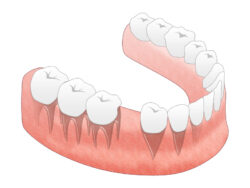
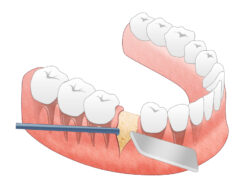
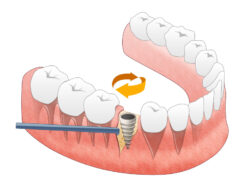
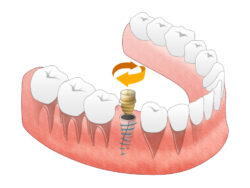
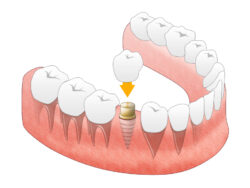
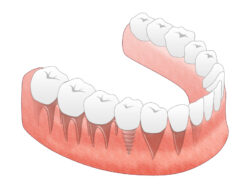
Fig. Implantation procedure
The implants placed in the bone are completely covered by the mucous membrane and no part of them is visible in the oral cavity.

Fig. Placement of implants in the bone
Osteointegration of the implant
During the healing of the tissues around the implant – the process of osseointegration (fusion of bone tissue with the implant) – we perform a temporary prosthetic restoration to aesthetically fill the gap left by the missing tooth before applying the final porcelain crown on the implant.
The stitches are removed 7–14 days after the procedure.
The implant integrates with the bone within 3-6 months. After this period, we perform another procedure involving the exposure of the implants and the placement of healing screws. These shape the gum and enable the attachment of a porcelain tooth crown to the implant.
In some cases, it is possible to place healing screws or a prosthetic connector on the implant during the initial implant placement procedure. This is referred to as single-stage surgical treatment.

Fig. Implants after implantation with healing screws
Immediate implantation
In some cases, it is possible to implant the implant directly into the tooth socket created after the removal of the tooth root. This is referred to as immediate implantation.

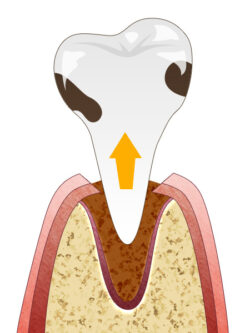
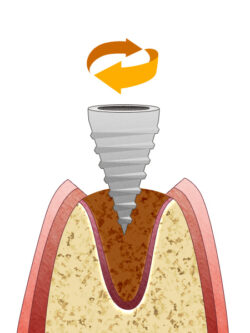

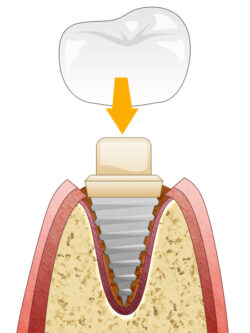
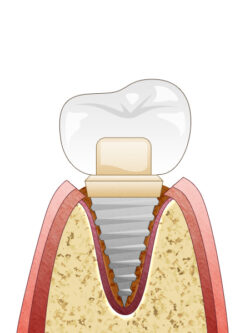
Fig. The course of immediate implantation
The prerequisites for immediate implantation are:
- a healthy tooth socket surrounded by healthy and thick bone tissue,
- atraumatic extraction – performed without damaging the bone tissue of the tooth socket,
- no acute inflammatory process,
- suitable anatomical conditions,
- suitable soft tissue shape
The main benefits of immediate implantation are:
- combination of extraction and implantation (minimal invasiveness of the procedure and faster healing),
- reduction in the number of patient visits to the clinic and thus a reduction in the total treatment time (by approx. 3 months),
- the possibility of preserving the original level of bone tissue,
- the possibility of making an immediate temporary crown (immediate loading of the implant).
During implantation, it may be necessary to fill the space between the implant and the alveolar wall with the patient’s bone or bone substitute material (e.g. Bio-Oss) and cover it with a special Bio-Gide membrane. In such cases, the treatment time is extended to approx. 6 months.
STAGE III. IMPLANTOPROTETICS
Once the tissue around the healing screws has healed, the dentist begins the most important part of the treatment for the final aesthetic result – the prosthetic restoration of the tooth crown on implants.

Fig. Implant connectors – the basis for prosthetic restoration
During this stage, special connectors made of titanium or zirconium oxide are attached to the implants, which form the basis for further prosthetic restoration of the tooth crown.
The dentist, in cooperation with a professional prosthetic laboratory, prepares an appropriate aesthetic prosthetic restoration (prosthetic crown or bridge) and cements it onto the connector.
In this way, the tooth is restored without the need to grind adjacent teeth, and, very importantly, the presence of the implant prevents bone loss at the site of implantation.

Fig. Placement of a prosthetic crown on an implant with an abutment
From now on, you can enjoy a beautiful, full smile and bite even hard nuts again!
Prosthetic restoration of several teeth on implants

In the case of several missing teeth, depending on individual circumstances and the treatment plan, we use two solutions:
- a prosthetic bridge attached to implants,
- separate crowns on implants inserted in the place of each missing tooth.
Step by step – prosthetic restoration of several teeth on implants

- Missing lateral teeth in the mandible (so-called winged edentulism)

- Implants are inserted into the mandible bone – they do not affect adjacent teeth

- Separate aesthetic porcelain crowns are placed on the implants in the place of each missing tooth

- The prosthetic bridge is attached to the implants

- Aesthetic restorations: crowns or bridges placed on implants function, look and feel like real teeth
Prosthetic restoration of an edentulous upper or lower jaw
Implant-prosthetic treatment is also the best solution in cases of complete tooth loss in the upper or lower jaw.
In order to aesthetically restore complete tooth loss and at the same time ensure full bite functionality, we recommend one of the following options:
Complete denture (bridge) permanently attached to several implants (4 to 8)
A permanently fixed denture significantly increases the comfort of use. Chewing forces are transferred to the bone, which protects it from atrophy. At any time, the dentist can unscrew the denture to examine and clean it in hard-to-reach areas.
Overdenture (removable) attached to a minimum of two or more implants using anchoring elements
Overdentures are restorations that meet aesthetic requirements, protect the jawbone from resorption and provide satisfactory comfort for the patient. They are attached to the patient’s own tooth roots or implants using clasps, magnets, telescopic crowns or bar attachments.

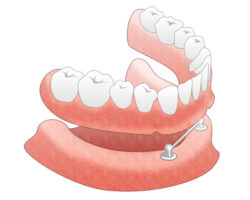
Fig. Prosthetic restoration of an edentulous jaw
A prerequisite for using dentures is maintaining perfect oral hygiene and attending regular check-ups!
Temporary prosthetic restorations
In order to ensure that the patient looks good and feels comfortable during the implant and prosthetic treatment process, while the tissue around the implant heals and osseointegration (the fusion of bone tissue with the implant) takes place, we will make temporary prosthetic restoration (crowns, adhesive bridge or denture). In this way, we will temporarily fill the gap left by the missing tooth in an aesthetic manner before applying the final porcelain crown to the implant.
If the patient used a denture before the procedure, we can modify it appropriately for the duration of implant healing so that it serves as a temporary restoration before the implanted implants are loaded with the final prosthetic restoration.
Bone reconstruction – maxillary sinus lift
In order for the implantation procedure to be successful, it is necessary to have a sufficient quantity and quality of bone in the planned implant site.
In many cases, due to insufficient bone quantity or a bone structure that is not conducive to the procedure, additional bone reconstruction procedures are necessary.
The following factors contribute to bone loss:
- too long a period between tooth loss and implantation (over the years, there is a gradual process of bone loss in both the mandible and maxilla); the optimal period for implant placement is 3-6 months after tooth extraction,
- tooth loss as a result of mechanical trauma;
- tooth loss as a result of periodontal disease (periodontitis);
- periapical inflammation;
- complicated and traumatic extractions during which the bone tissue of the tooth socket was damaged,
- long-term use of partial or complete dentures, which adversely transfer pressure forces through the gums to the bone, causing its recession (atrophy).
We use the following techniques to reconstruct the bone tissue necessary for implant procedures:
- guided bone regeneration and guided tissue regeneration using biomaterials such as Bio-Oss and Bio-Gide,
- autografting,
- splitting of the maxillary or mandibular ridge (ridge splitting),
- condensation (osteotomy method),
- osteodistraction,
- Olany-type augmentation,
- sinus lift.
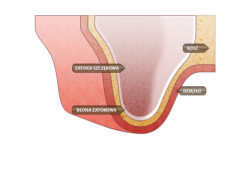
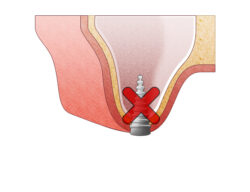

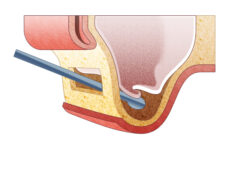
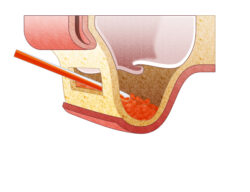
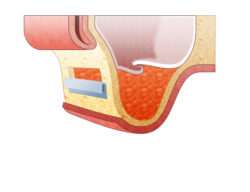
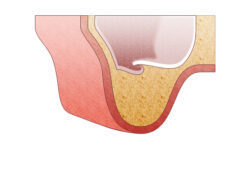
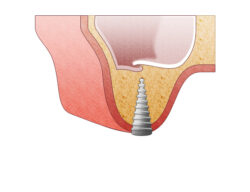
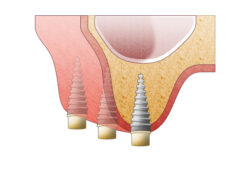
Fig. The course of the sinus lift procedure before implantation.
Post-implant procedure
After the implantation procedure, you should strictly follow your doctor’s recommendations and, at the same time, dispel any doubts regarding post-operative care.
Usually, the doctor recommends that you:
- take antibiotics and painkillers strictly according to his instructions,
- apply cold compresses in the initial post-operative period,
- refrain from eating and drinking for 2 hours after the procedure,
- avoid brushing the operated area until the stitches are removed; to prevent plaque build-up, we recommend using mouthwashes containing 0.1% chlorhexidine (Corsodyl, Eludril),
- after approx. 7-14 days, it is recommended to use a special soft post-operative toothbrush and take special care around the wound,
- eat a soft diet (avoid hard foods),
- avoid hot foods and drinks,
- chew food on the opposite side to the operated side,
- avoid physical exertion for the period specified by your doctor,
- attend follow-up appointments,
- refrain from smoking and drinking alcohol for several days after the procedure,
- do not use saunas, solariums, etc.,
- have the stitches removed 7-14 days after the procedure.
Regular and thorough oral hygiene will allow you to enjoy your implants for many years to come!
Implant warranty
After the procedure, the patient receives an implant passport ensuring implantological assistance, if necessary, from any Biomet3i partner in Poland and worldwide. The implant passport is a certificate of warranty rights, the details of which will be presented during the initial consultation visit.
The conditions for maintaining warranty rights are:
- completion of the treatment originally planned with the patient,
- strict adherence to the doctor’s recommendations,
- maintaining proper oral hygiene,
- following the recommendations regarding hygiene and rules for the use of prosthetic restorations,
- attending follow-up appointments
- the first one 2 weeks after the procedure,
- the second one after a month,
- the next one after 3 months,
- and subsequent ones regularly every 6 months.
Is implant placement painful?
The implant placement procedure is completely painless. The bone and gum are anaesthetised using traditional methods or a special electronic device called SleeperOne, which analyses tissue resistance and adjusts the pressure of the anaesthetic so that it does not exceed the pain threshold.
It is also possible to perform the procedure under light sedation (inhalation sedation with laughing gas) or deep sedation (i.e. under general anaesthesia).
We reassure every patient who feels anxious about the implantation procedure and assure them that it is much more tolerable than a tooth extraction. We guarantee that any discomfort will be kept to a minimum and that you will receive the highest level of professional care.
How long does the implant procedure take?
The implant procedure usually takes between 30 and 90 minutes, depending on the type, location and number of implants.
Will I feel pain once the anaesthetic wears off?
After the surgical procedure, your dentist will prescribe appropriate painkillers. If you take them as recommended by your dentist, pain and discomfort after the procedure will be kept to a minimum.
How long does the implant treatment and healing period last?
The process of osseointegration, i.e. the fusion of bone tissue with the implant, usually takes:
- 2 to 3 months for implants placed in the mandible,
- 3 to 9 months for implants placed in the maxilla.
Usually, it is only after this period that the implants can be loaded with a prosthetic restoration. During the healing of the tissues around the implant, we perform a temporary restoration. 7-14 days after the implantation procedure, we remove the sutures securing the wound.
After the implant has integrated with the bone tissue, we perform a procedure to expose the implants and place healing abutments. In some cases, it is possible to place healing abutments on the implant during the initial implant placement procedure.
Two to four weeks after healing and the formation of gum tissue around the healing screws, it is possible to begin the most important part of the treatment to guarantee a perfect aesthetic effect – the prosthetic restoration of the tooth crown on the implants.
Prosthetic restoration of the tooth crown (teeth) on implants requires 2-4 visits to the clinic and usually takes several days.
How should implants be cared for?
Dental implants should be cared for in the same way as your own teeth.
Implants are placed in the oral cavity, where conditions are variable – physiological changes, systemic diseases and other conditions occur with age. Therefore, follow-up visits after treatment according to the above schedule are very important.
What happens if the body rejects the implant?
In international clinical studies, the rate of successful integration of the implant with the bone is 98% three years after surgery and 95% five years after surgery.
If the implant is rejected by the body, it must be removed and the site allowed to heal. In most cases, it is possible to perform a re-implantation procedure in the same location.