

Dental surgery

At the ARTIMEDICA Holistic Centre for Implantology, Orthodontics and Prosthodontics, we perform all oral surgery procedures that do not require hospitalisation.
Dental surgery is a field of medicine dealing with surgical treatment of the oral cavity and maxillofacial region.
Patients most often associate it with tooth extraction, but thanks to current developments in medicine and the use of modern technologies and materials, we are able to keep the number of extractions to a minimum.
Our first priority is to protect our patients’ natural teeth.
Preparation for surgery: tomography
A CT scan enables the doctor to make an early and accurate diagnosis and prepare an appropriate treatment plan.
Surgical procedures require exceptional precision and early accurate diagnosis. An integral tool in planning and preparing a treatment plan at an early stage is tomographic examination.
At the ARTIMEDICA clinic, we use CBCT 3D cone beam computed tomography for this purpose. At present, this is the most accurate method of non-invasive diagnosis. It allows us to create a realistic three-dimensional image of the internal tissues of the examined area.
Anaesthesia in dental surgery
To ensure maximum comfort for the patient, all dental surgery procedures are performed under anaesthesia.
The procedures are performed under local anaesthesia. To improve their effectiveness and patient comfort, we use a specialised computerised anaesthetic delivery system called SleeperOne and/or inhalation sedation with nitrous oxide.
Implantation – insertion of implants
Implantation is the most modern and best method of restoring lost teeth, both in terms of aesthetics and functionality.
Implantation is a surgical procedure involving the placement of an implant in the bone. It is the second part of implant-prosthetic treatment, after diagnosis, and precedes prosthetic restoration on implants.
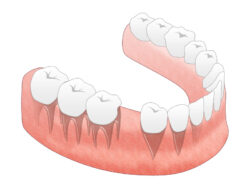
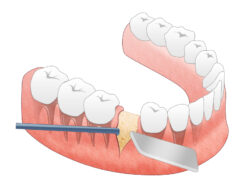
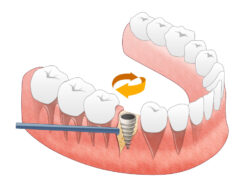


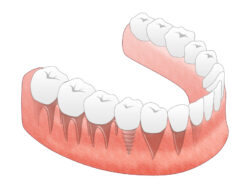
Fig. Implantation procedure
In the first phase of the implantation procedure, an incision is made in the gum and the bone is exposed. In the next phase, the surgeon makes a hole in the jawbone and places the implant in it. The procedure is usually performed under local anaesthesia and lasts from 30 to 120 minutes, depending on the number of implants and additional procedures.
Gum plastic surgery – periodontal surgery
A beautiful smile is not only about beautiful, healthy teeth, but also about the healthy and beautiful periodontal tissues surrounding them. The task of periodontal surgery is to support the conservative treatment of diseases of the tissues surrounding the teeth, i.e. the periodontium.
Chirurgia plastyczna dziąseł to:
- likwidacja uśmiechu dziąsłowego – tzw. gummy smile,
- wydłużenie klinicznej korony zęba,
- pokrycie recesji dziąsłowych,
- podcięcie wędzidełka wargi górnej i języka – frenulektomia,
- gingiwoplastyka,
- plastyka dziąsła i wyrostka kostnego,
- zabiegi regeneracyjne z użyciem biomateriałów kościotwórczych,
- poszerzenie strefy dziąsła rogowaciejącego,
- plastyka lub pogłębienie przedsionka jamy ustnej,
- inne.
Extraction – removal of a tooth
Tooth extraction is a surgical procedure during which a tooth is removed from the tooth socket. It is performed as a last resort when no other treatment is possible.
Indications for tooth extraction include:
- complete destruction of the tooth by caries and the inability to treat it,
- serious mechanical injury (vertical fracture) and the impossibility of conservative or prosthetic treatment,
- prosthetic or orthodontic indications.
Extractions of impacted teeth concern teeth that have already reached their full development but are not completely erupted. They may be completely or partially invisible in the oral cavity. Most often these are wisdom teeth (eights), upper canines, supernumerary and additional teeth. It is not always necessary to remove them.
Impacted teeth are eligible for extraction, i.e. removal, when:
- inflammation occurs in the tissues surrounding the tooth,
- they cause ongoing inflammation in adjacent teeth,
- they hinder the proper growth of teeth (supernumerary and additional teeth),
- cause pain due to pressure on neighbouring teeth, for example,
- there are prosthetic or orthodontic indications.
Hemisection and radectomy
Hemisection and radectomy concern multi-rooted teeth and are surgical procedures which, under favourable circumstances, allow a tooth that has been “written off” to be saved.
In the case of multi-rooted teeth, there is a chance to preserve the part of the tooth that has not been affected by inflammation.
- Hemisection – a procedure involving the removal of the root affected by inflammation along with part of the tooth crown; the remaining half of the tooth is secured with a prosthetic restoration. Hemisection can only be performed if the endodontic treatment has been successful and the tissues surrounding the remaining part of the tooth are healthy.
- Radectomy – a procedure involving the removal of only the root affected by the inflammatory process.
Root tip resection
Resection treatment allows the tooth to be saved from extraction.
Root tip resection involves removing the tip of the tooth root along with any inflammatory lesions. The root is secured and the bone defect (if necessary) is filled with bone substitute biomaterial. Thanks to advances in endodontic treatment, this procedure is performed relatively rarely, in cases of:
- anatomical reasons preventing proper root canal treatment,
- when repeat treatment (reendo) does not bring the desired results,
- presence of periapical lesions, when repeat endodontic treatment is not possible (prosthetic work has been performed on the tooth and a crown-root inlay has been placed in the canal),
- when a root cyst with a diameter greater than 8-10 mm has formed.
Pre-prosthetic and implant surgery
Pre-prosthetic and implant surgery includes dental surgery procedures aimed at preparing the site for a future implant or prosthetic work.
- deepening/plasty of the oral vestibule,
- cutting the upper lip frenulum,
- reconstruction/restoration of the alveolar ridge,
- plasty/improvement of the shape of the alveolar ridge.